In-depth Article · SPIRE SeriesJune 24, 2026

Chuỗi nội dung: Workplace Wellbeing through the SPIRE Model — HSRC 2026

What Is the SPIRE Model?

A Guide to Applying It in Life and Work

SSpiritual
PPhysical
IIntellectual
RRelational
EEmotional
SPIRE Model — HSRC

Home / Bulletin / What is the SPIRE Model?

HSRC Center7 min readHappiness Science · SPIRE

Happiness Can Be Learned, Practiced, and Measured

For decades, happiness was considered something "given by fate" — you either had it or you didn't. But modern happiness science, particularly through the research of Professor Tal Ben-Shahar at Harvard, has proven the opposite:

Happiness is a skill. And skills can be learned, practiced, and developed.

The SPIRE model is one of Tal Ben-Shahar's most important contributions to the field — a comprehensive framework that helps us understand and cultivate happiness across every area of life.

What Is SPIRE?

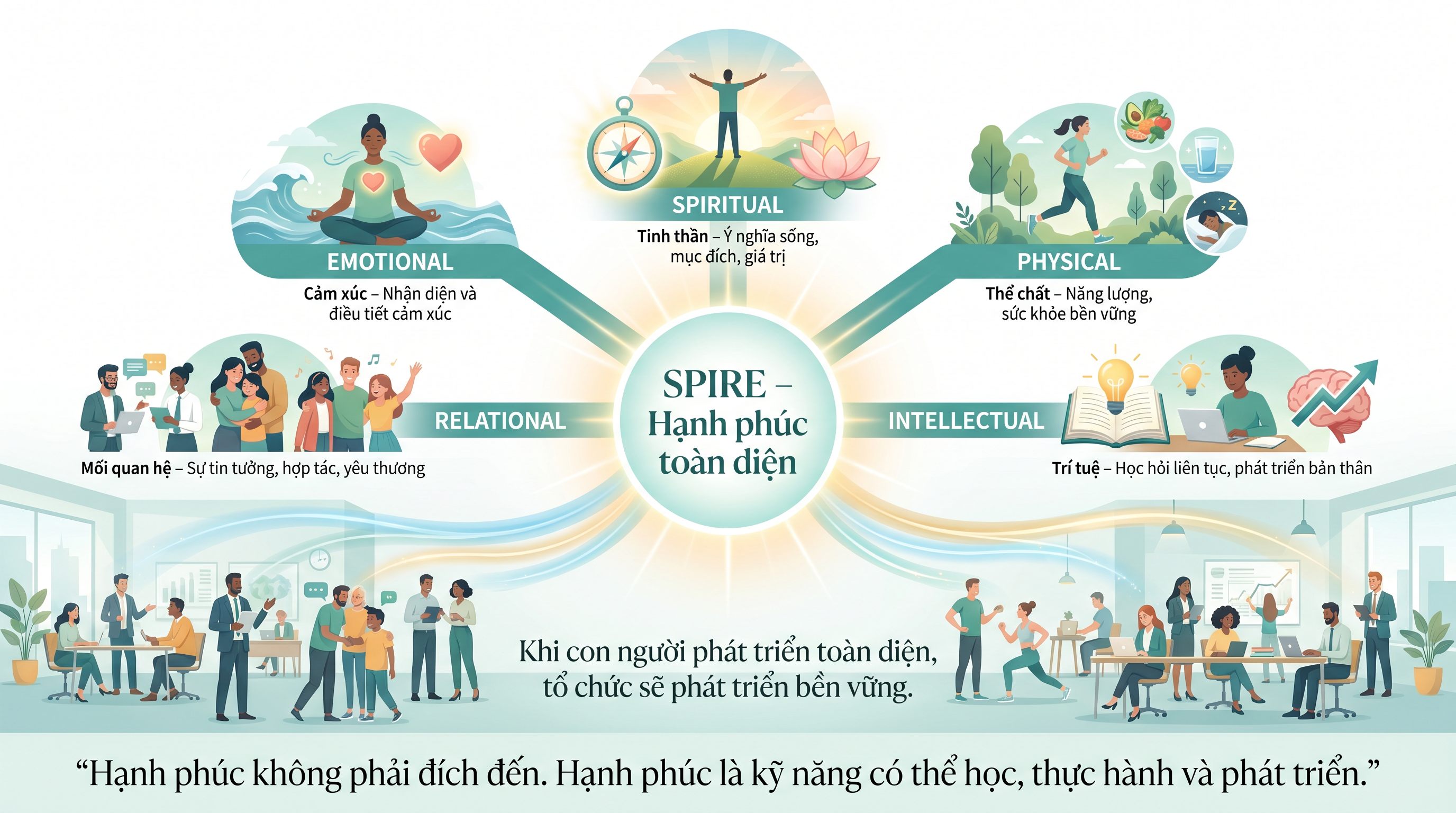
SPIRE stands for the 5 pillars of comprehensive wellbeing:

S01
SpiritualMeaning & Purpose

Seeking meaning, purpose, and value in what you do every day. It doesn't have to be spiritual or religious — it's the question: "What does what I'm doing mean to me and to others?"

P02
PhysicalBody & Health

Caring for the body through movement, nutrition, rest, and sleep. Physical health doesn't just affect wellness — it directly influences mood, energy, and cognitive capacity.

I03
IntellectualGrowth & Curiosity

Nurturing curiosity, love of learning, and a growth mindset. Intellectual happiness doesn't come from knowing a lot, but from always being open to learning more — even from failure.

R04
RelationalConnection & Trust

Building and nurturing quality relationships with colleagues, family, friends, and community. Research consistently shows that relationship quality is one of the strongest predictors of happiness.

E05
EmotionalResilience & Regulation

Recognizing, accepting, and regulating emotions — including difficult ones. Happiness does not mean always being cheerful, but having the capacity to recover after hard times.

Why Is SPIRE Different from Other Wellbeing Models?

What makes SPIRE distinctive is its comprehensiveness and interconnection. Many wellbeing programs focus on only one aspect — usually physical (gym, yoga) or emotional (mindfulness, stress management). SPIRE views people as a whole: when one pillar weakens, the others are also affected.

For example: someone who is sleep-deprived (P) will struggle to regulate emotions (E), find it hard to focus and learn (I), and may become irritable in relationships (R). Conversely, when someone finds meaning in their work (S), they tend to take better care of themselves and connect more deeply with others.

Applying SPIRE in the Workplace

At HSRC, we apply the SPIRE model to the Vietnamese business context through the Happy Business Program — a journey of 5 experiential workshops, each going deep into one SPIRE pillar with specific practical tools:
S
Job CraftingCrafting meaning in daily work
P
MVIMinimal Viable Improvements to sustain lasting energy
I
Growth MindsetLearning and adaptive thinking in a volatile environment
R
Positive CommunicationBuilding a culture of connection and trust
E
Emotional RegulationManaging emotions and building resilience

Where to Begin?

You don't need to change all 5 pillars at once. Dr. Tal Ben-Shahar often emphasizes the philosophy of "small but sustainable": choose the smallest change you can maintain consistently and start there.

A question to reflect on today: Of the 5 SPIRE pillars, which one needs your attention most?

References

  1. Ben-Shahar, T. (2007). Happier: Learn the Secrets to Daily Joy and Lasting Fulfillment. McGraw-Hill.
  2. Ben-Shahar, T. (2021). Happier, No Matter What: Cultivating Hope, Resilience, and Purpose in Hard Times. The Experiment.
  3. Seligman, M. E. P. (2011). Flourish: A Visionary New Understanding of Happiness and Well-being. Free Press.
  4. Wrzesniewski, A., & Dutton, J. E. (2001). Crafting a job: Revisioning employees as active crafters of their work. Academy of Management Review, 26(2), 179–201.
#HSRC#HappinessScience#HolisticHappiness#SPIREModel#Workshop#MeaningAtWork#WorkplaceWellbeing
← Back to Bulletin
Workshop · Tháng 7 / 2026

Chương trình Doanh nghiệp Hạnh phúc

HSRC's "Crafting Meaning at Work" Workshop will take place in July 2026. HSRC provides full support at no cost to pioneer businesses in the pilot phase.

📞 +84 823 495 676📧 info@hsrc.vn🌐 hsrc.vn
Learn about SPIREContact HSRC
Liên hệ với chúng tôi